
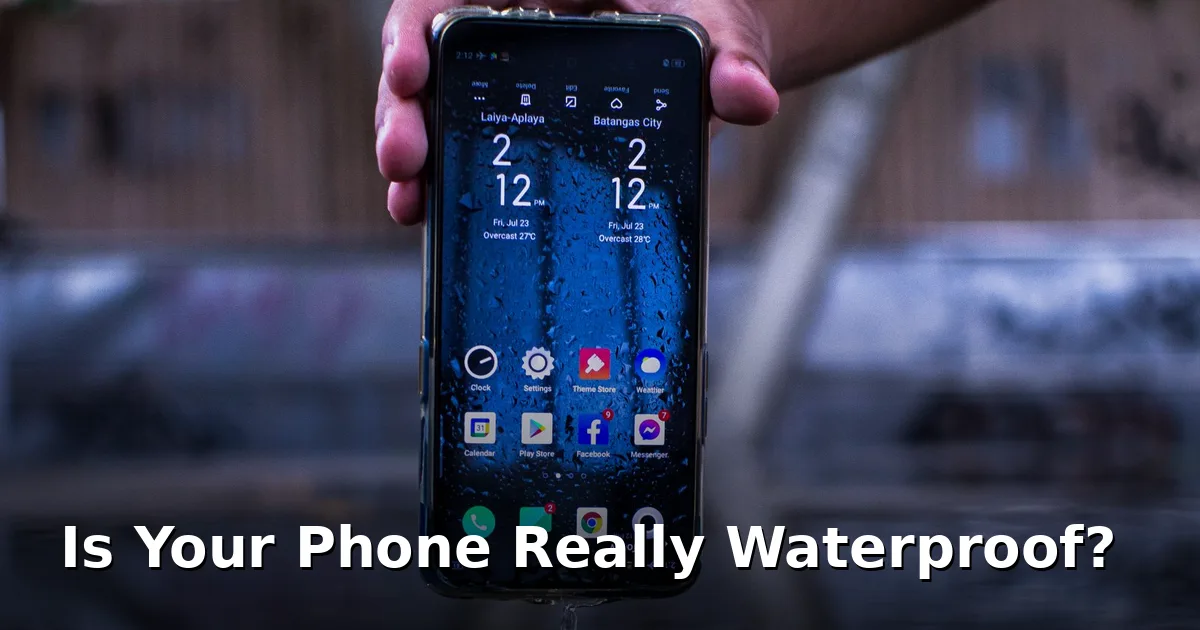
Everyone asks it after the splash: is my phone waterproof? Adverts show phones surviving pools and rain, and “IP68” sounds reassuring — but misunderstanding it is how phones die. Here’s what IP ratings mean, what your phone can and can’t survive, and how to protect it.
Water-Resistant vs Waterproof: The Crucial Difference
First: no mainstream phone is truly waterproof. Waterproof would mean impervious in any situation — no maker claims that. Phones are water-resistant to a defined, lab-tested level. And the catch: water damage is excluded from virtually every warranty — Apple and Samsung both state liquid damage isn’t covered, even on IP68 flagships. The badge is a safety net for accidents, not an invitation to swim. If water kills it, you pay.
IP Ratings Decoded in Plain English
IP (Ingress Protection) is the international standard for dust and water resistance. Each digit means something:
- First digit (0–6): dust. 6 is fully dust-tight — what most modern phones carry.
- Second digit (0–9): water. 7 survived the standard submersion test; 8 survived deeper or longer submersion as defined by the maker.
So IP68 = dust-tight + submersion-tested; IP67 = dust-tight + the shallower test; IPX7 = only the water test was done (dust unrated). Key nuance: tests run in still, fresh water on brand-new phones. Real life — movement, pressure, soap, salt, heat — is harsher.
What IP67 and IP68 Actually Survive
The rating covers everyday accidents: rain, splashes, a quick sink drop, a brief puddle dunk. What it does not cover:
- Swimming pools — chlorine attacks seals and coatings.
- The sea — salt water is corrosive. Rinse with fresh water fast if it happens.
- Hot tubs and hot showers — heat degrades adhesives; steam penetrates seals.
- High-pressure water — jets force water past seals that stop still water.
- Soapy water — detergents break down water-repellent coatings.
Depth and time limits vary by model — check your manufacturer’s specs rather than assuming all IP68 phones are equal.
How Water Seals Fail Over Time
Water resistance is perishable — gaskets, adhesives, and meshes all degrade. Drops shift seals microscopically. Heat (a phone baked in a car) softens adhesives. Age wears everything down: a three-year-old IP68 phone isn’t as protected as on day one. Repairs: any screen or battery replacement breaks the factory seal, rarely restored to standard. Survived a dunk last year? Don’t assume it will this year.
Your Phone Got Wet Anyway? Do This Now
- Power off immediately. Don’t test whether it works — electricity plus water causes the corrosion that kills phones.
- Don’t charge it until every port is fully dry.
- Dry the outside with a soft cloth; air-dry somewhere ventilated. Skip the hairdryer.
- Eject speaker water with a water-ejection tone — see how to get water out of your phone speaker.
- Full rescue plan: our phone-dropped-in-water first aid guide.
Protecting the Speaker After Water Exposure
The speaker is usually the first thing to sound wrong after a dunk — water sits in the mesh and chamber. It’s also the easiest fix: a water-ejection tone vibrates the membrane and pushes droplets out. Sceptical? Read whether water-eject sounds actually work, then run the tone with the speaker facing down. And never charge until the port is fully dry.
Waterproof Cases vs Trusting the Rating
If you regularly take your phone near water, don’t rely on the rating alone — a proper waterproof pouch (IP68-rated in its own right, ideally with a lanyard) costs little and removes the gamble. Think of the IP rating as your airbag and the case as your seatbelt: you want both, but drive assuming the airbag might not deploy. Check the case’s seals before each use.
Frequently Asked Questions
Is my phone waterproof if it says IP68?
No — water-resistant, not waterproof. It passed lab submersion tests in fresh water when new. That doesn’t cover salt, chlorine, hot water, pressure, or aged seals. Liquid damage voids the warranty.
What does IPX7 mean?
The X means dust wasn’t rated — only the water test was done. Most modern phones carry a full IP67 or IP68 instead.
Can I take underwater photos with an IP68 phone?
Physically yes, but makers advise against it — chemicals, salt, and pressure exceed lab conditions, and damage won’t be warranty-covered. Use a dedicated case for underwater shots.
My speaker sounds muffled after getting wet — is it ruined?
Probably just trapped water in the mesh. Dry fully, don’t charge yet, and run a water-ejection tone. Still wrong after a day or two? Get it checked.
Does water resistance wear off?
Yes. Drops, heat, age, and any repair that opens the phone degrade the seals. Protection is best on day one and declines from there.
Are waterproof pouches better than the IP rating?
For deliberate water exposure, yes. A good pouch is cheap insurance independent of your seals’ condition — and actually designed for swimming and beach days, unlike the lab-tested rating.
Just survived a splash or planning a beach holiday? Bookmark our free speaker cleaner tool — its water-ejection tone can save a soaked speaker in under a minute.

2 Comments
Comments are closed.