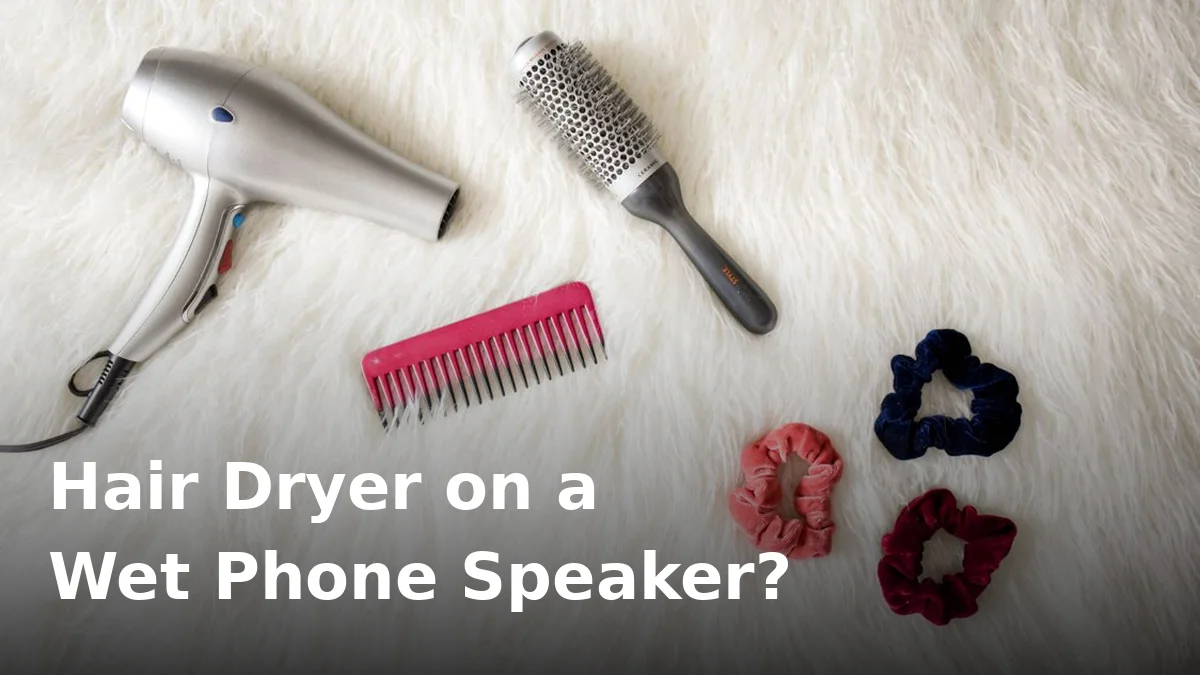
Your phone just got wet, the speaker sounds muffled, and there is a hair dryer in the bathroom drawer. It feels like the obvious fix: blow the water out with hot air, fast. It is also one of the most common ways people turn a recoverable wet phone into a damaged one — not because a hair dryer is always harmful, but because heat, distance, and timing all matter, and most people get at least one of them wrong.
Here is the honest answer: a hair dryer on a cool setting, held at a distance, is mostly harmless. A hair dryer on hot, held close, is a bad idea. And in most cases, you do not need a hair dryer at all.
Why heat is the problem, not air
A phone speaker is a tiny, delicate assembly glued into a sealed body, sitting next to a battery that really does not like heat. Hot air aimed at the speaker grille can:
- Soften adhesives that hold the screen and back in place, weakening the phone’s water resistance even after it dries.
- Damage the battery. Lithium batteries degrade faster with heat, and a hot battery in a wet phone is a combination you do not want.
- Warp the speaker mesh and driver. The mesh is thin and the diaphragm is thinner; sustained heat can distort both, leaving you with a permanently buzzy speaker.
- Push water deeper. A strong, hot jet does not just evaporate surface water — it can drive droplets further into the phone, past the grille and into areas that were still dry.
None of this happens instantly from a few seconds of warm air, which is why the advice is confusing. The risk builds with temperature, closeness, and time — exactly the three things people increase when they are impatient for the phone to dry.
The only hair-dryer method that is safe
If you are going to use a hair dryer at all, this is the only version worth doing:
- Set it to cool only — no heat, no warm setting. If your dryer has no true cool setting, do not use it.
- Hold it at least 30 cm (about a foot) away from the phone, and keep it moving — never aimed at one spot.
- Use short bursts of a few seconds, not a continuous blast, with the speaker grille facing down so water can drain.
- Stop as soon as the outside looks dry. The dryer has done its job at that point; anything still inside needs time, not more air.
Even done this way, a hair dryer is slower and less effective than people expect. It dries the surface, not the inside, and the speaker will still sound muffled until the internal moisture evaporates on its own.
What works better than a hair dryer
For a wet phone speaker, the methods that actually help are boring, which is why they lose out to the hair dryer in the moment:
- Gravity first. Hold the phone speaker-down and let water drain, then wipe the outside dry.
- A water-eject tone. A low-frequency tone vibrates the speaker and pushes droplets out of the mesh — the same principle as the Apple Watch’s water eject. Run it a few times at normal volume, as described in our water-eject guide.
- Open air and time. Leave the phone in a ventilated room, speaker-down on a dry cloth. A splash often clears within an hour; a submerged phone can take a day or two. Our guide to how long water stays in a phone speaker sets out realistic timelines.
- A fan from across the room. Cool, moving air from a distance is the hair-dryer method done properly — and it does not tempt you to turn the heat up.
What does not work, despite its reputation, is rice. It dries a phone no faster than open air and can leave dust in the speaker and port, as we explain in our rice myth guide.
What if you already used a hot hair dryer?
Do not panic — a brief blast probably did no lasting harm. Check for these warning signs over the next day:
- The speaker buzzes or distorts at volumes that were previously fine.
- The screen or back feels loose, or you can see a gap in the seal.
- The phone gets unusually hot during normal use or charging.
- The battery drains noticeably faster than before.
If any of those appear, stop using the speaker at high volume and get the phone checked. If the phone seems normal and the sound is gradually improving as it dries, you most likely got away with it — just do not repeat the experiment.
The same warning applies elsewhere
The hair-dryer temptation is not limited to phone speakers. Do not use hot air on a wet charging port, a wet Bluetooth speaker, or wet earbuds either — the same heat and adhesive risks apply, and a charging port that looks dry on the outside can still be wet inside. If you have a wet Bluetooth speaker to deal with, the drying rules are the same: cool air, distance, and patience.
Frequently Asked Questions
Can I use a hair dryer on a wet phone at all?
Only on a cool setting, from at least 30 cm away, in short bursts. Hot air risks the battery, adhesives, and speaker itself.
Will a hair dryer dry out my phone speaker faster?
Only the surface. Internal moisture still needs time and airflow to evaporate, so a hair dryer saves minutes at best and risks damage at worst.
Is it safe to use a hair dryer on the charging port?
No, not on hot, and cool air should be kept at a distance. Let the port air-dry fully before charging — charging through a wet port is far riskier than a damp speaker.
My phone speaker still sounds muffled after using a hair dryer. What now?
Give it more time in open air and run a water-eject tone a few times. If it is still muffled after 24–48 hours, the speaker may be blocked or damaged — see our guide to telling a blown speaker from a blocked one.
What is the fastest safe way to dry a wet phone speaker?
Drain it speaker-down, run a water-eject tone, then leave it in ventilated air. There is no instant safe shortcut — patience is the fastest method that does not risk damage.
The bottom line
Cool air from a distance: fine, if unexciting. Hot air up close: the fastest way to turn a wet speaker into a damaged one. Put the hair dryer away, run the free speaker cleaner tone instead, and let time do the rest.